A constrained, segmented market with resilient premium pockets | Q1 2026
Cover: View of Rabat from Hassan Tower plaza by Steven C. Price, CC BY-SA 4.0; cropped and colour-graded.
Data through Q1 2026 | Published August 2026
PROPRIETARY MARKET ANALYSIS
Jawad El Hassani Sbai
CEO, Chestertons Morocco
Signed for publication | August 2026
Global vision. Local expertise.
Jawad's Rabat reading
MY CITY VIEW I see Rabat as the most sharply reset of the ten major cities reported: prices fell 4.7% and transactions 55.4% quarter-on-quarter. The pressure was concentrated in residential property, while urban land rose 9.5% on a much smaller decline in activity.
Segment
Price q/q
Price y/y
Transactions q/q
Interpretation
All property
-4.7%
-0.7%
-55.4%
Worst major-city reset
Residential
-6.2%
-0.4%
-56.6%
Core source of price stress
Urban land
+9.5%
-3.1%
-28.3%
Quarterly rebound, weak annual trend
Professional
-1.0%
-1.7%
-59.5%
Prices steadier than turnover
Sources: Bank Al-Maghrib / ANCFCC bulletin and detailed workbook; y/y calculations from index levels.
The quarterly headline is severe, but the annual all-property price change is only -0.7%. That difference indicates a sudden Q1 reset rather than a multi-year collapse. The transaction measure is not seasonally adjusted, and the latest city observation can be revised.
Residential breakdown
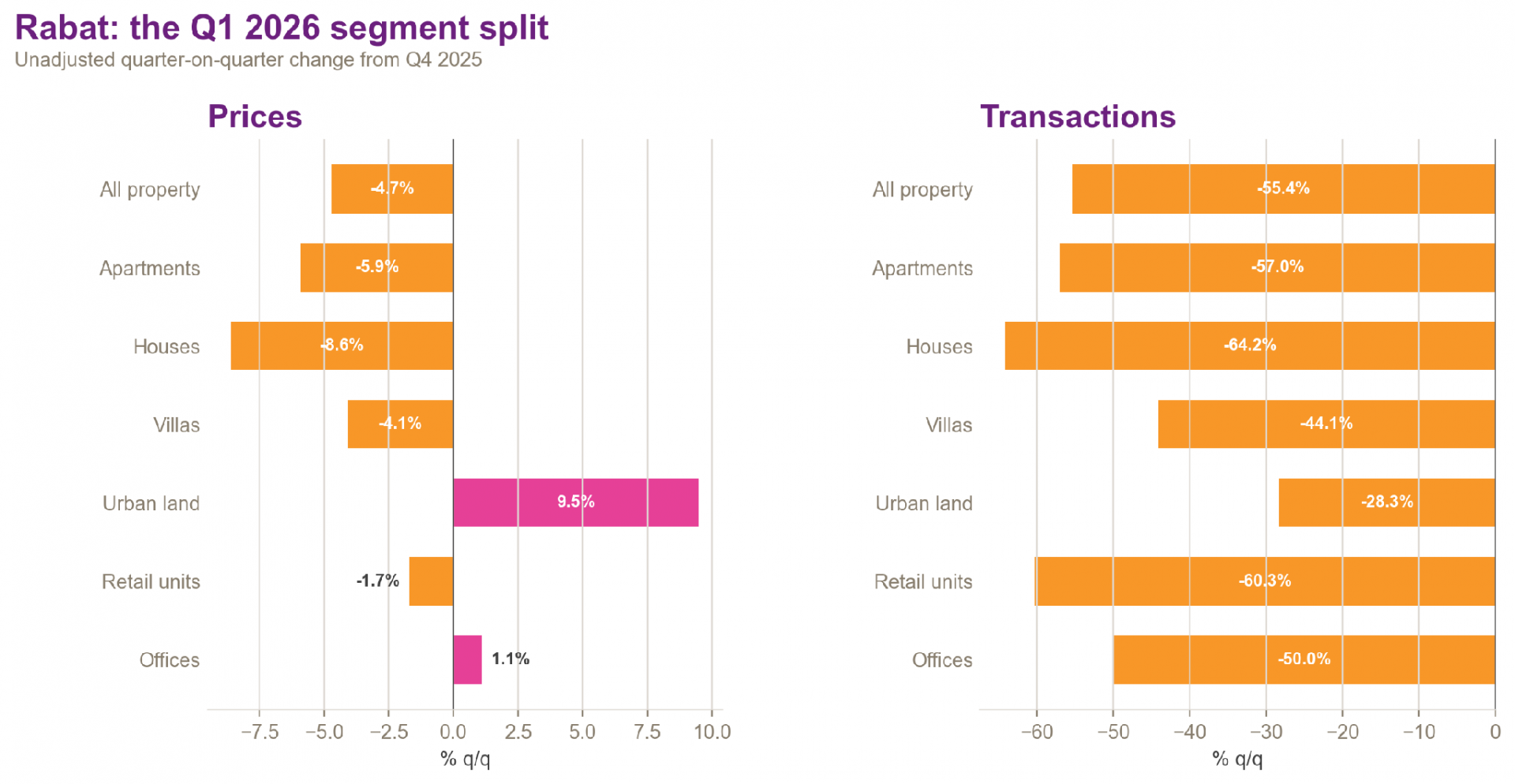
Houses were the weakest subsegment: prices fell 8.6% quarter-on-quarter and 6.9% year-on-year, while transactions fell 64.2%. Apartments fell 5.9% in the quarter but were approximately flat year-on-year (+0.05% from the detailed index). Villas fell 4.1% in the quarter yet remained 1.1% above Q1 2025.
A split market beneath the headline
Figure 1. Rabat Q1 2026 price and transaction changes
Source: Bank Al-Maghrib / ANCFCC Q1 2026; Chestertons Morocco Research, analysis by Jawad El Hassani Sbai.
The land move needs caution
Urban land increased 9.5% quarter-on-quarter, the strongest category move in the city, while transactions fell 28.3%. But the same land index was 3.1% below Q1 2025 and 10.9% below Q1 2021. Its quarterly volatility since 2006 is about 6.6%, versus 1.9% for Rabat's overall index. The Q1 rise is therefore better read as a volatile counter-move or mix effect than as proof of a broad land boom.
Professional property did not escape the freeze
Professional prices fell only 1.0%, but transactions dropped 59.5%. Retail units fell 1.7% in price and 60.3% in activity. Offices moved in the opposite price direction (+1.1%) even as transactions fell 50.0%. Thin samples and mix can amplify office and retail index moves, so the direction is more reliable than a precise valuation conclusion.
Rabat in long-run context
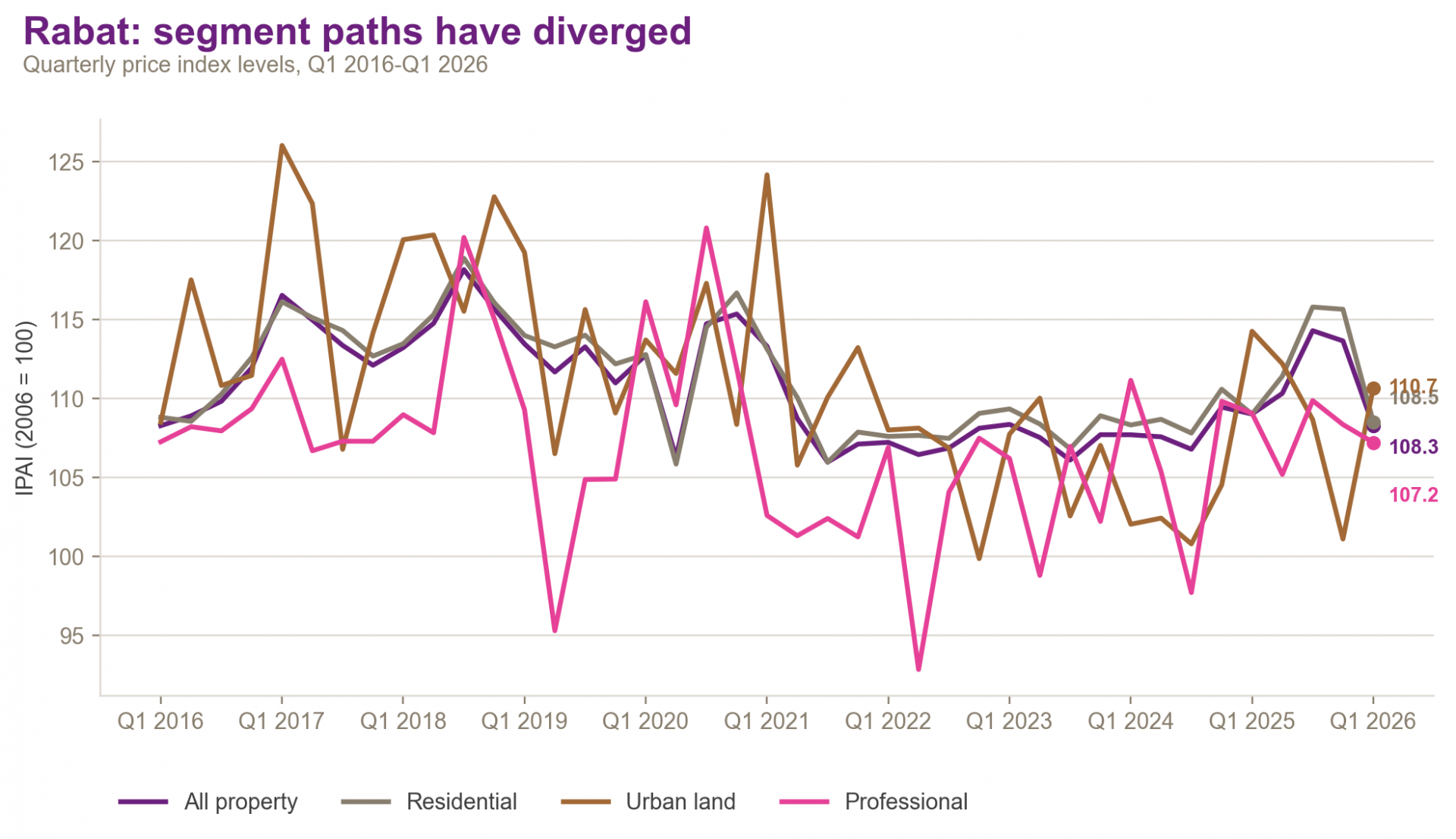
Figure 2. Rabat price index levels since 2016
Source: detailed Bank Al-Maghrib / ANCFCC workbook; calculations by Jawad El Hassani Sbai for Chestertons Morocco Research. Base 100 = 2006.
The Rabat all-property index is 108.3: 8.3% above its 2006 base, essentially unchanged from Q1 2016, 4.5% below Q1 2021 and 8.4% below its Q3 2018 peak. The Q1 2026 move is the weakest first-quarter price change in the available Rabat history.
The long-run chart also shows why a single-city average needs segmentation. Residential broadly follows the headline index, but land and professional assets are substantially more volatile. A city allocation based only on the -4.7% headline would miss both the land rebound and the positive quarterly office move.
Market interpretation and external context
Demand and financing
National real-estate credit was still expanding at end-March 2026: +3.4% year-on-year overall, +2.9% for housing and +4.8% for developers, according to DEPF. This does not contradict Rabat's transaction fall because credit outstanding is a stock measure, while registered transactions are a flow. The key city-level question is whether new mortgage production and buyer conversion improve in Q2.
Supply and execution
National cement sales fell 10.9% in Q1, with DEPF linking early weakness to exceptional rain and Ramadan timing. This offers a partial construction-side explanation but cannot account for Rabat's much larger transaction decline. Media coverage has also highlighted developer concerns over costs and regulation; these are sentiment inputs, not substitutes for registry data.
Policy cushion
Direct housing aid is supporting eligible buyers nationwide, with 101,521 beneficiaries by 7 May. The available official update does not publish a Rabat-specific Q1 split, so the programme should be treated as national demand support rather than a quantified explanation for this city's quarterly result.
MY DATA DISCIPLINE I would not infer a Rabat land boom from +9.5% q/q or a citywide crash from -55.4% transactions. The first is volatile and negative year-on-year; the second is unadjusted and compared with Q4.
Chestertons Morocco field intelligence
WHAT OUR DAILY WORK ADDS The registered-sales index describes completed repeat transactions. Our mandates, negotiations and client conversations show a more segmented Rabat market: scarcity and off-plan activity are supporting selected neighbourhoods even while the published city aggregate is weak.
Why the headline can understate resilient pockets
The citywide figures combine neighbourhoods with very different supply-demand balances. In the most sought-after districts, limited resale stock and persistent buyer interest are containing price pressure. At the same time, a meaningful share of current demand is directed towards off-plan properties. Reservations and first sales in new schemes are not necessarily captured promptly - or at all - by a repeat-sales index that requires the same property to transact at least twice. The IPAI can therefore look weaker than the operating market in specific new-build pockets without either signal being wrong.
Land scarcity is restricting residential delivery
Rabat's developable residential land bank is scarce and difficult to replenish. This limits the number of schemes that can be launched, raises the entry cost for developers and supports higher asking prices for well-located new product. The likely result is a market with fewer transactions but firmer prices in scarce, specification-led developments. The quarterly land index remains volatile, yet the structural scarcity behind new residential supply is a genuine operating constraint.
Demand is widening into the metropolitan fringe
Part of Rabat's demand is shifting rather than disappearing. Buyers seeking larger homes, newer specifications or better value are extending their search into neighbouring suburban areas, notably Menzeh and Harhoura. This metropolitan spillover enlarges the effective Rabat demand basin and creates opportunities for carefully positioned family housing outside the traditional core.
Owners remain resistant on price
Many owners are testing the market rather than selling under pressure. They set aspirational prices, wait for the right buyer and often withdraw instead of accepting a discount. In scarce micro-markets this creates seller-led price discovery: completed volumes remain low because buyers resist the premium, but owners' holding power prevents a rapid repricing. I would describe Rabat as a seller's market only in these supply-constrained pockets, not across the entire city.
MY FIELD CONCLUSION Rabat's low transaction count is partly a scarcity and price-discovery story. Limited land, off-plan concentration and suburban spillover provide a more constructive medium-term reading than the headline Q1 figures alone.
My Q2-Q4 2026 outlook
Base case: selective recovery with firm scarce-stock pricing
My base case combines a mechanical rebound from Q1's low transaction base with continued segmentation. Scarce central stock and credible off-plan developments should retain pricing power, while less differentiated resale property may take longer to clear. Demand migration towards Menzeh, Harhoura and other connected suburban locations should support the wider metropolitan market even if central Rabat transaction volumes remain constrained.
Upside signals
The constructive case would strengthen if off-plan reservations convert into registered completions, annual transaction growth approaches zero, apartment prices remain positive year-on-year and new suburban schemes record healthy absorption without excessive incentives. Housing-credit growth translating into new originations would add further support.
Downside signals
The principal risks are a widening gap between sellers' expectations and buyers' budgets, prolonged off-plan delivery schedules, or suburban supply expanding faster than end-user demand. A second quarter of weak annual transactions accompanied by renewed apartment and villa price declines would indicate that Q1 was more than a seasonal pause.
Methodology and sources
Rabat indices use the Bank Al-Maghrib / ANCFCC repeat-sales methodology, base 100 in 2006. Only properties with at least two observed transactions enter the index; minimum transaction thresholds apply. Data are cut 35 days after quarter-end and can be revised. The IPAI is not a price-per-square-metre measure and does not capture rents or total returns. Field intelligence reflects qualitative observations from Chestertons Morocco's day-to-day mandates, negotiations and client interactions; it is directional, not a statistically representative survey. The interpretation, calculations and forward-looking judgements are my proprietary analysis for Chestertons Morocco.
CHESTERTONS MOROCCO RESEARCHMorocco property marketNational trend report | Q1 2026[[media code="q7vmbrw71f"]]Cover: Rabat by Steven C. Price (CC BY-SA 4.0) and Marrakech by Federico Mata (CC BY 3.0); cropped and colour-graded.Data through Q1 2026 | Published August 2026PROPRIETARY MARKET ANALYSISJawad El Hassani SbaiCEO, Chestertons MoroccoSigned for publication | August 2026Gl...
Affiliés de la marque Chestertons
Nous sommes fiers de célébrer une étape historique – cette année, Chestertons fête ses 220 ans d’excellence dans l’immobilier.Cet anniversaire marque non seulement plus de deux siècles de confiance, d’intégrité et d’expertise, mais aussi 20 ans depuis l...
CHESTERTONS MOROCCO RESEARCHMarrakech property marketLiquidity paused, while premium demand and the new-build pipeline point forward | Q1 2026 [[media code="uaayyqcp2b"]]Cover: Koutoubia, Marrakech by Federico Mata, CC BY 3.0; cropped and colour-graded.Data through Q1 2026 | Published August 2026PROPRIETARY MARKET ANALYSISJawad El Hassani SbaiCEO, Chestertons MoroccoSigned for...